
Development-making cultural heritage: music, mats and videos
Peru a missing story in the making of the transnational indigenous movement
The birth of the transnational indigenous movement in 1992 profoundly shaped human rights advocacy and multicultural legislation in Latin America. Yet Peru is a persistent absence in academic literatures on its emergence, which generally hold that indigenous identities were not politicised to the same extent as in the neighbouring countries of Bolivia and Ecuador. Some point to the long armed-conflict and the anti-indigenous stance of the Shining Path to account for this absence but few question its historical accuracy. Here we provide evidence that a vibrant transnational indigenous community was indeed being built in Peru in the lead up to 1992, it just depends on where one looks for it.
Indigenous evangelical Quechua music festivals, decolonising agenda
During the 1980s indigenous music festivals proliferated across the evangelical Quechua speaking world, promoting new forms of worship to reflect the music, instruments, clothing and language of the Andes. Research has collected firsthand accounts of why the festivals came about and what it felt like to be part of this movement. A whole generation of young people became inspired to take up the quena (Andean flute), Zampoña (Andean pipes), mandolin, charango (Andean lute), violin, harp and guitar and to write new songs for worship and evangelism.

“More than anything it was to make visible the gifts and skills of the brothers and sisters [hermanos] from different places and to create worship in the Andean style [forma Andina] … They [the festival organisers] said that the hymn book that we sang was imported from England from over in Europe and that we must have our own creation here in Peru from the Andes because otherwise we mainly sang … in a European tone. (Festival participant, Interview Andahuaylas, 2008).
Solidarity through music during armed conflict
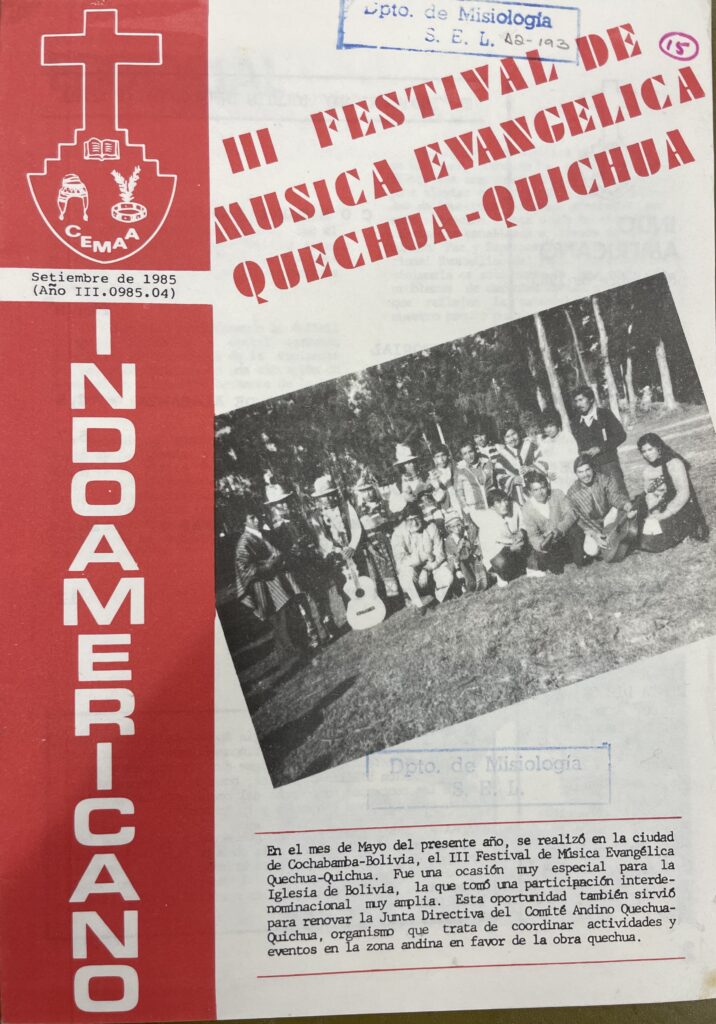
In 1979, one year before the Shining Path launched its bombing campaign in Ayacucho, the first international festival took place in the city. Interviews and archives reveal a rich history of how local and international festivals helped build and strengthen the emergence of a transnational Quechua/Quichua Christian community. By the time the third international festival took place in Cochabamba, Bolivia in 1985, the violence between the Shining Path and paramilitaries had escalated and direct attacks on churches occurred alongside atrocities inflicted on the wider Quechua community in the southern Peruvian Andes.. In this context the transnational indigenous evangelical community showed its solidarity. Despite the harsh economic situation in Bolivia at the time, a collection (‘ofrenda’) was taken up for those impacted by the violence in Peru.
Lost music found!
Very few of the many artisan recordings made in the 1980s during the festivals have survived locally. In oral history interviews carried out three decades later, one participant spoke about wishing she could play a recording of herself singing with her group to her teenage son so that he would know that she had ‘a life’ before he came along. Another woman remembered that her young toddler (now an adult himself with children) used to treat the cassettes as toys, unwinding the tapes and so destroying the music. In 2008, a charango player spoke of his surprise at having recently heard his own band playing one of their original songs on a Christian radio station broadcasting in Quechua from Ecuador. He was in the garden behind his house, listening on a transistor radio but could not get to his tape player quickly enough to hit the record button.
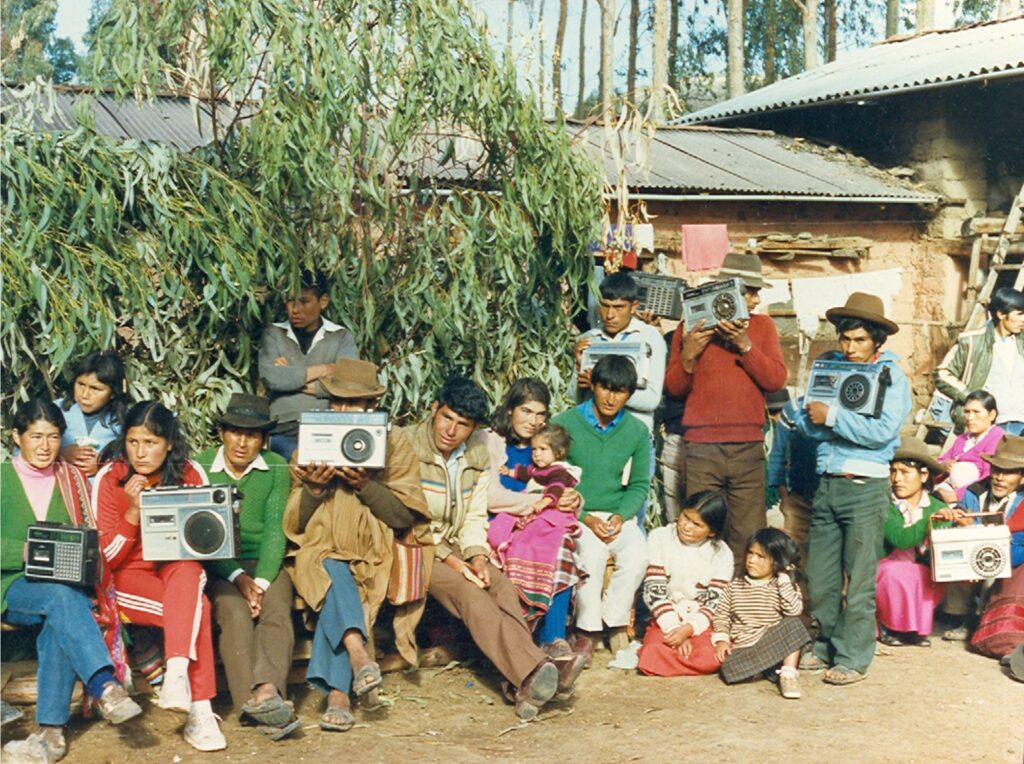
Photography credit: Cherry Noble
“Just recently I heard it [a recording of our group playing], just by chance, and hearing it I ran in to tell my family”. (Festival participant, Interview Andahuaylas, 2008)
One exciting recent development has been the unexpected unearthing of some original cassette recordings of music from festivals in Apurimac, believed by musicians and festival goers to have been lost over time. One comprises two cassettes in a personal archive of a retired British missionary who played the music to animate still images she used to describe her work in Apurimac to British churches in the 1980s and 1990s. The second set of recordings, from 1985, is held in the British Library’s National Sound Library in London. It comprises more than 200 catalogued entries for digitised copies of original Quechua music recordings made on cassette by an Edinburgh University music student in August and September 1985. It includes eighteen songs performed by different groups at a festival held in Umaca that year.
The local, regional and international Quechua-Quichua music festivals that took place in Peru in the 1980s created a long-lasting legacy that changed both the landscape of indigenous identity making in the church and the soundscape of evangelical worship. In turn, leading up to 1992, they played a unique role in Peru’s contribution to the construction of an Andean transnational indigenous movement.